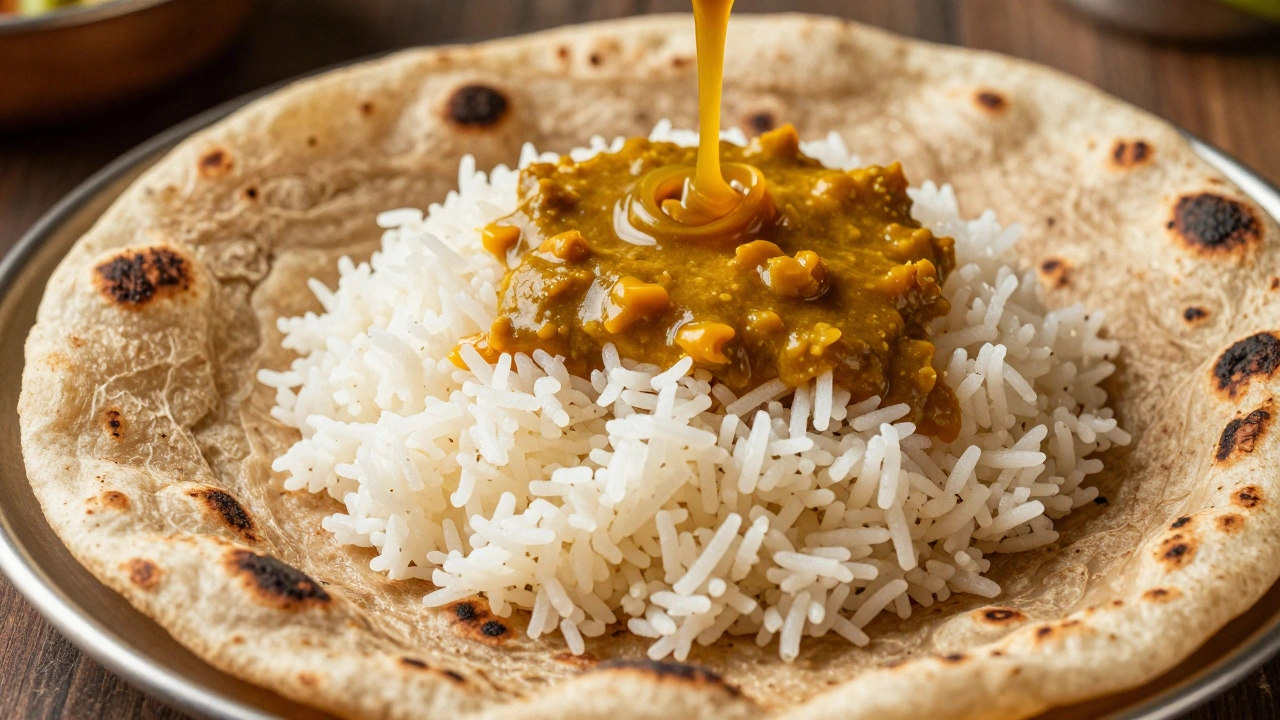
The Science of the Stack: Interactive Plating Guide
Step 1: The Foundation
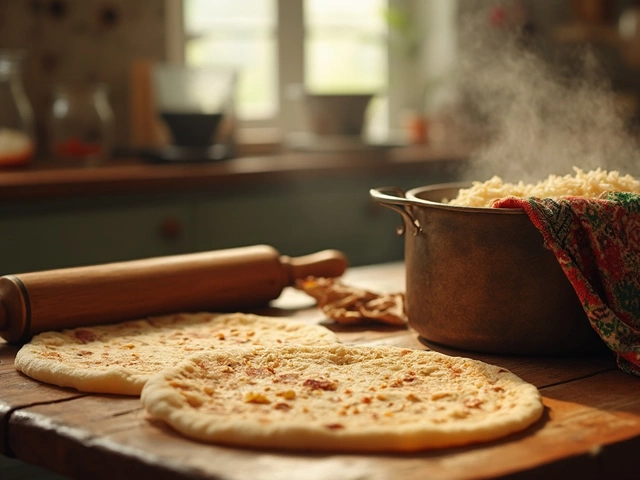
Start with a warm plate. Place the fresh, hot roti on the bottom. This provides a sturdy base for your meal.
You’ve probably seen it at a family dinner or a bustling street stall: a mound of steaming white rice sitting proudly on top of a warm, charred roti. It looks like an accident. It feels like a mistake. But if you ask anyone who grew up in a South Asian household, this isn’t chaos-it’s strategy. So, why do you put rice over roti? Is it just to keep the bread from getting soggy? Or is there a deeper culinary logic at play?
The short answer is texture management and portion control. But the real story involves the interplay between starches, the mechanics of eating with your hands, and the specific way we serve dal (lentil soup) and curries. Let’s break down exactly why this seemingly odd presentation is actually one of the smartest ways to eat a meal.
The Sogginess Factor: Protecting Your Roti
Think about what happens when you pour a liquid curry directly onto a soft, porous flatbread. Within seconds, the roti absorbs the moisture. It becomes heavy, limp, and difficult to fold. If you’re trying to wrap that roti around some vegetables or meat, it tears. It’s messy. It’s frustrating.
Rice acts as a buffer. When you place a scoop of dry or slightly moist rice on top of the roti, you create a physical barrier. The curry goes on top of the rice, not the bread. This keeps the roti crisp on the outside and pliable on the inside. You can still fold it, tear it, and use it to scoop up the flavorful gravy without losing structural integrity.
- Structural Integrity: Roti stays firm enough to hold ingredients.
- Moisture Control: Prevents the bread from turning into mush.
- Eating Mechanics: Makes hand-eating significantly cleaner.
This is especially important for tandoori roti or naan, which are thicker and more absorbent than thin phulka. If you’ve ever tried to eat a saucy butter chicken with a soggy naan, you know exactly why this layer matters.
The “Scraping” Technique: Getting Every Last Bit
In many parts of India and Pakistan, the goal of a meal isn’t just to fill your stomach-it’s to clean the plate. We call this “scraping.” You take a piece of roti, dip it into the dal or curry, and scrape off the clinging sauce. But here’s the problem: if the curry is too watery, it slides right off the roti. If it’s too thick, it clumps up and doesn’t spread evenly.
Rice changes the dynamics of this interaction. When you mix a little bit of rice with your curry, it creates a thicker, more cohesive mixture. The grains act like tiny anchors, helping the sauce adhere to the surface of the roti. When you press the roti against the rice-curry mix, you get a perfect bite: a bit of bread, a bit of grain, and plenty of flavor.
This technique is particularly common with dal makhani or sabzi (vegetable curries). The rice ensures that every spoonful has a balanced ratio of carb to protein, rather than having a mouthful of just plain bread or just plain lentils.
Temperature Regulation: Keeping Things Warm
Have you noticed how quickly roti cools down once it leaves the tawa (griddle)? A fresh roti is hot, airy, and delicious. Ten minutes later, it’s hard as a rock. Rice, on the other hand, retains heat much longer due to its density and moisture content.
By placing the hot rice on top of the roti, you’re essentially using the rice as a thermal blanket. The residual heat from the rice helps keep the roti underneath warm and soft for a longer period. This is crucial in settings where meals are served all at once but eaten slowly, like during long family dinners or festive gatherings.
If you serve them separately, the roti sits exposed to the air, drying out. Stacked together, they form a micro-climate that preserves the best qualities of both foods until you’re ready to eat.
Cultural Context: The Dal Chawal vs. Roti Debate
To understand this habit, you have to look at regional food cultures. In North India, wheat is king. Roti is the staple. Rice is often a side dish or reserved for special occasions like biryani or pulao. In South India, it’s the opposite: rice is the main event, and flatbreads like dosa or idli are secondary.
But in many households, especially in urban areas or mixed-region families, people want both. They crave the comfort of dal chawal (lentils and rice) but also want the heartiness of roti. Putting rice over roti is a compromise. It allows you to enjoy the textures of both staples in a single serving without needing two separate plates.
This fusion style is also very common in street food stalls. Vendors need to pack maximum flavor and nutrition into a small space. A plate with roti at the bottom and rice on top saves space, reduces waste, and makes it easier for customers to eat on the go.
Practical Tips for Perfect Plating
If you want to try this method at home, here are a few tips to make sure it works well:
- Use Dry Rice: Make sure your rice is fluffy and not overly wet. Wet rice will steam the roti and make it soggy anyway.
- Warm the Plate: Heat your serving plate before adding the roti. This prevents the bread from cooling down instantly.
- Don’t Overload: A small scoop of rice is enough. You don’t need a mountain; just enough to cover the center of the roti.
- Add Curry Last: Pour your dal or curry over the rice, letting it drip down the sides onto the roti. This distributes the flavor evenly.
Avoid using very oily curries if you’re stacking them high, as the oil can seep through the rice and make the roti greasy. Instead, opt for creamy gravies like paneer butter masala or thick lentil soups.
Is It Necessary? Not Always.
Let’s be clear: you don’t *have* to put rice over roti. Many people prefer their carbs separate. If you’re eating a dry curry (like a stir-fry or a bhujia), there’s no need for a rice buffer. The same goes if you’re dipping your roti into a chutney or a dry pickle.
The rice-on-roti method shines specifically with liquid-heavy dishes. If your meal consists of dry components, skip the stack. Keep it simple. Serve the roti on the side and let it stay crisp.
The Psychological Comfort of Familiarity
Beyond the physics and chemistry, there’s an emotional component. For many of us, seeing rice on top of roti triggers a sense of nostalgia. It reminds us of childhood meals, of mothers rushing to serve food before it gets cold, of crowded tables where everyone shares from the same pot.
It’s a visual cue that says, “This is a complete meal.” It signals abundance and care. Even if you’re eating alone in Cape Town or New York, arranging your plate this way can make the experience feel more authentic, more connected to your roots.
Can I put rice under the roti instead?
Technically yes, but it defeats the purpose. If the rice is underneath, the roti sits directly on the plate, and any curry poured on top will soak straight into the bread. The rice needs to be the middle layer to act as a shield.
Does this work with paratha too?
Absolutely. Parathas are even more absorbent than regular rotis because of the layered dough and ghee. Using rice as a buffer is highly recommended when eating parathas with dal or spicy curries to prevent sogginess.
What type of rice is best for this?
Long-grain basmati rice is ideal because it stays separate and fluffy. Short-grain or sticky rice might clump together and create a dense block that doesn’t distribute well with the curry.
Is this practice common in South India?
Less so. In South India, rice is usually served on a banana leaf or a large plate, with curries poured directly onto it. Flatbreads like dosa are eaten separately. The rice-on-roti stack is more of a North Indian or Pan-Indian urban adaptation.
Why not just eat the rice and roti separately?
Some people prefer separation for dietary reasons or personal taste. However, stacking them saves space on the plate, keeps the food warmer, and simplifies the mixing process for those who like to combine flavors in each bite.